

Remus from ModBargains
Get the best deals on Remus
ModBargains is an authorized dealer of Remus
Sound | Design | Power


About Remus Sport Exhaust
Let your car be heard while also increasing horsepower and torque output with a Remus exhaust system. All of the exhaust systems feature straight-through mufflers for an unrestricted exhaust flow that will not only give your BMW, Audi, VW, or Mini new found power output, but an aggressive new exhaust note.
We stock many Remus exhaust systems here at our warehouse for the fastest possible shipping times. If you are looking for a specific Remus exhaust system that you don't see listed on our site please contact us - We can get any Remus exhaust for you.
Motorsport Pedigree
Since the beginning, the commitment to Motor Sport has been an essential part of the company philosophy. The first sport mufflers to leave the new factory in Bärnbach during spring 1991 already wore trade marks from motor sport participation within the National Rally Championship. Not only the vital image transfer from the “track to the street” was addressed, but also the technology transfer to ensure that clients receive the best possible sport exhaust for their cars.
Today REMUS can be found as a sponsor and development partner in various motor sport projects. In the DTM REMUS equips all six racing cars of the Mercedes AMG DTM team with high-performance Inconel exhaust systems.
Highest Level of Quality
REMUS manufactures using the latest state of the art machinery to ensure top quality for a global market Modern machinery, such as laser cutting, Hydro forming and CNC controlled pipe bending machines combined with special processing techniques guarantee products with exceptional forms and perfect fitment. Thin steel welding processes, in manual form and robotic controlled play an important part in the manufacturing process of REMUS high quality sport exhaust systems.
Certification such as ISO 9001, ISO 14001 and even ISO/TS 16949 which is required within the automobile industry proves that the world leader in sport exhausts is an experienced and competent partner for the international automotive industry.
Sound Engineering
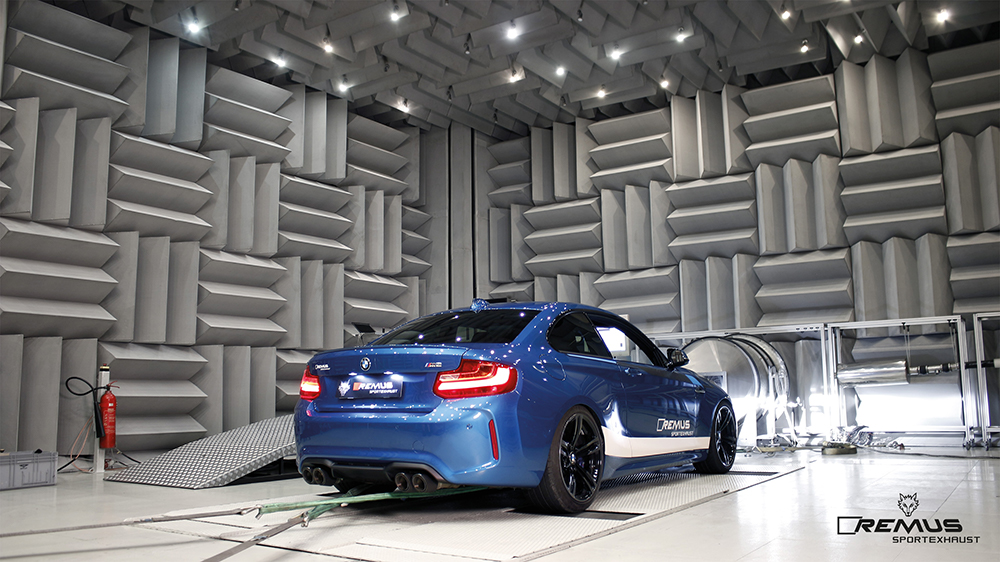
REMUS R&D Department uses state of the art technology to design their exhaust systems for optimal power, performance, and sound quality. The REMUS R&D Center is equiped with a highly modern acoustic sound chamer with a 4WD Dyno which can simulate different driving conditions for Performance and Sound tuning. In the REMUS acoustic laboratory sound can be individually optimised, ranging from full racing sound to sonorous street sound.
The acoustic test room offers the possibility of carrying out all acoustic measurements under standardized conditions. Apart from the obvious insulation against all external noise, this room absorbs virtually all noise directly emitted by the measured object. This prevents reflections, echo and hall effects and ensures -conclusive, repeatable measurements.